Stroke
Stroke
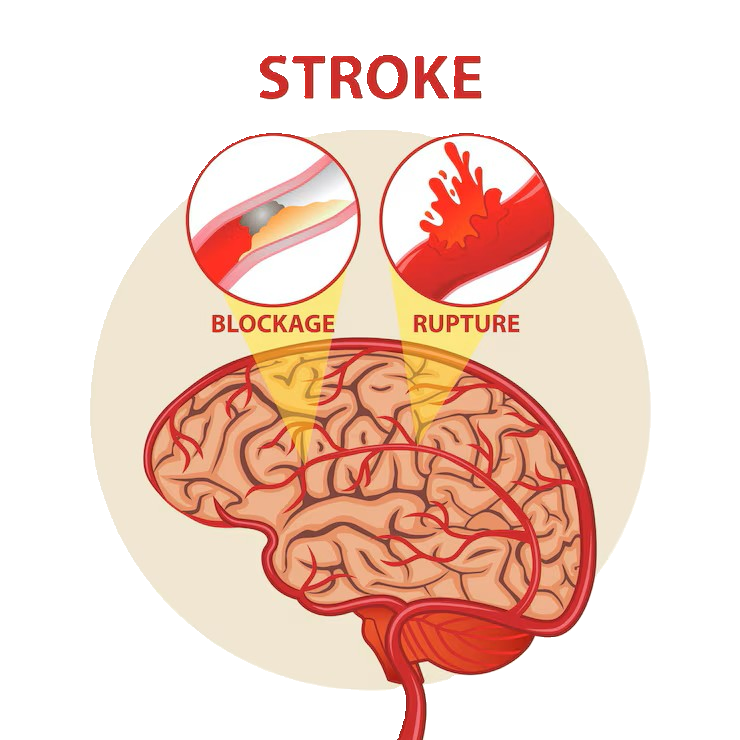
A stroke occurs when the blood supply to part of the brain is suddenly interrupted or when a blood vessel in the brain bursts, spilling blood into the spaces surrounding brain cells. Brain cells die when they no longer receive oxygen and nutrients from the blood, or when blood suddenly bleeds into or around the brain. The symptoms of a stroke include sudden numbness or weakness, especially on one side of the body; sudden confusion or trouble speaking or understanding speech; sudden trouble seeing in one or both eyes; sudden trouble with walking, dizziness, or loss of balance or coordination; or sudden severe headache with no known cause. There are two forms of stroke: ischemic – blockage of a blood vessel supplying the brain, and hemorrhagic – bleeding into or around the brain.
Generally there are three treatment stages for stroke: prevention, therapy immediately after the stroke, and post-stroke rehabilitation. Therapies to prevent a first or recurrent stroke are based on treating an individual’s underlying risk factors for stroke, such as hypertension, atrial fibrillation, and diabetes. Acute stroke therapies try to stop a stroke while it is happening by quickly dissolving the blood clot causing an ischemic stroke or by stopping the bleeding of a hemorrhagic stroke. Post-stroke rehabilitation helps individuals overcome disabilities that result from stroke damage. Medication or drug therapy is the most common treatment for stroke. The most popular classes of drugs used to prevent or treat stroke are antithrombotics (antiplatelet agents and anticoagulants) and thrombolytics.
Although stroke is a disease of the brain, it can affect the entire body. A common disability that results from stroke is complete paralysis on one side of the body, called hemiplegia. A related disability that is not as debilitating as paralysis is one-sided weakness, or hemiparesis. Stroke may cause problems with thinking, awareness, attention, learning, judgment, and memory. Stroke survivors often have problems understanding or forming speech. A stroke can lead to emotional problems. Stroke patients may have difficulty controlling their emotions or may express inappropriate emotions. Many stroke patients experience depression. Stroke survivors may also have numbness or strange sensations. Pain is often worse in the hands and feet and worsens with movement and temperature changes, especially cold.
Recurrent stroke is frequent; about 25 percent of people who recover from their first stroke will have another stroke within 5 years.
- What You Need to Know about Stroke – Stroke publication education booklet
- Transient Ischemic Attack Information Page – Transient Ischemic Attack (TIA) information sheet compiled by the National Institute of Neurological Disorders and Stroke (NINDS).
- Stroke: Hope Through Research – An informational booklet about stroke compiled by the National Institute of Neurological Disorders and Stroke (NINDS).
- Stroke Scales and Related Information – Download free versions of NIH Stroke Scale and Related Information. Graphical and text PDFs available. More information for clinicians about acute stroke.
- Stroke Risk Factors and Symptoms – A short document describing stroke risk factors and symptoms.
- Stroke Rehabilitation Information – Stroke rehabilitation information, resources, and statistics. Discusses the effects of stroke, types of rehabilitation programs, and how to prevent another stroke.
- Stroke fact sheet available in multiple languages through MedlinePlus
- Questions and Answers About Treating Arterial Stenosis and Preventing Stroke – Treatments of stenosis include medication and lifestyle changes. Surgery, such as carotid endarterectomy or placement of a stent, is recommended in some cases.
- Questions and Answers About Stroke – Strokes can be ischemic (blood vessel blockage) or hemorrhagic (brain bleeding). Read about symptoms, risk factors, and the need to act fast in case of a stroke.
- Questions and Answers About Carotid Endarterectomy – Carotid endarterectomy can prevent stroke in some patients. Diagnosis of carotid artery disease, blood vessel blockage, and stroke risk factors are discussed.
- Post-Stroke Rehabilitation Fact Sheet – Post-stroke rehabilitation fact sheet from the National Institute of Neurological Disorders and Stroke (NINDS)
- Neurological Diagnostic Tests and Procedures – Fact sheet on neurological diagnosis and testing, prepared by the National Institute of Neurological Disorders and Stroke (NINDS).
- Multi-Infarct Dementia Information Page – Multi-infarct dementia information sheet compiled by the National Institute of Neurological Disorders and Stroke (NINDS).
- Lo Que Necesita Saber Sobre Los Ataques Cerebrales
- Know Stroke, Know the Signs, Act in Time – Stroke public education booklet
- Conozca qué son los Ataques o Derrames Cerebrales. Conozca las señales.
- Cómo Prevenir un Accidente Cerebrovascular
- Brain Basics: Preventing Stroke – Brain Basics Series. Healthy living habits can prevent stroke. Read about the risk factors and warning signs of stroke. Includes charts to score your stroke risk.
- Apoplejía : Factores de Riesgo y Síntomas
- Accidente Cerebrovascular: Esperanza en la Investigación
- Order NINDS Publications

7272 Greenville Avenue
Dallas, TX 75231-4596
strokeinfo@heart.org
www.strokeassociation.org
Tel: 888-4STROKE (478-7653)

269 Hanover Street, Building 3
Hanover, MA 02339
office@bafound.org
www.bafound.org
Tel: 781-826-5556
888-BRAIN02 (272-4602)
31 Center Drive
Room 8A07
Bethesda, MD 20892-2540
www.brainattackcoalition.org
Tel: 301-496-5751

201 Chicago Avenue, Suite 200
Minneapolis, MN 55415
info@childneurologyfoundation.org
www.childneurologyfoundation.org
Tel: 612-928-6325
4101 West Green Oaks Blvd.
Suite 305
PMB 149
Arlington, TX 76016
info437@chasa.org
chasa.org
Tel: 817-492-4325
20325 Center Ridge Road Suite 620
Rocky River, OH 44116
admin@fmdsa.org
www.fmdsa.org
Tel: 216-834-2410
888-709-7089

785 Park Road, #3E
New York, NY 10021
anne@thegoddessfund.org
www.thegoddessfund.org

1325 G Street, N.W.
Suite 400
Washington, DC 20005
support@heartrhythmfoundation.org
www.hrsonline.org
Tel: 202-464-3454
Joe Niekro Foundation
12707 High Bluff Drive
Suite 200
San Diego, CA 92130-2035
info@joeniekrofoundation.com
www.joeniekrofoundation.com
Tel: 877-803-7650
P.O. Box 87
Scarsdale, NY 10583
naa@aphasia.org
www.aphasia.org
Tel: 212-267-2814
800-922-4NAA (4622)
https://www.stroke.org/
9707 East Easter Lane
Suite B
Centennial, CO 80112-3747
info@stroke.org
www.stroke.org
Tel: 303-649-9299
800-STROKES (787-6537)

P.O. Box 692
Conway, SC 29528
info@youngstroke.org
www.youngstroke.org
Tel: 843-248-9019
843-655-2835
Disclaimer:
APS Foundation of America, Inc. is not intended to replace standard doctor-patient visits, physical examinations, and medical testing. The information provided to members is only an opinion. Confirm all information with your personal doctor. Always seek the advice of a trained physician in person before seeking any new treatment regarding your medical diagnosis or condition. Any information received from APS Foundation of America, Inc. is not intended to diagnose, treat, or cure. This brochure is for informational purposes only.
If you think you may have a medical emergency, call your doctor or 911 immediately.
A team of people contributed to this publication. Where to find this information: http://www.ninds.nih.gov/disorders/stroke/stroke.htm
Prepared by:
Office of Communications and Public Liaison
National Institute of Neurological Disorders and Stroke
National Institutes of Health
Bethesda, MD 20892
NINDS health-related material is provided for information purposes only and does not necessarily represent endorsement by or an official position of the National Institute of Neurological Disorders and Stroke or any other Federal agency. Obtain advice on the treatment or care of an individual patient through consultation with a physician who has examined that patient or is familiar with that patient’s medical history.
All NINDS-prepared information is in the public domain and may be freely copied. Credit to the NINDS or the NIH is appreciated.