Deep Vein Thrombosis (DVT)
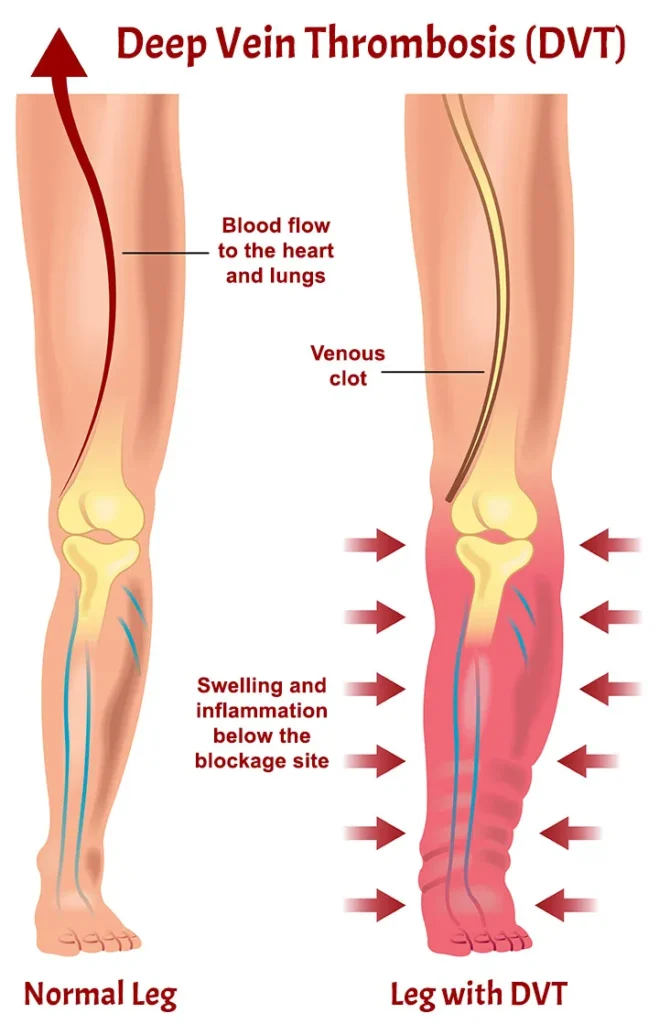
Deep Vein Thrombosis
Deep vein thrombosis (throm-BO-sis), or DVT, is a blood clot that forms in a vein deep in the body. Blood clots occur when blood thickens and clumps together.
Most deep vein blood clots occur in the lower leg or thigh. They also can occur in other parts of the body.
A blood clot in a deep vein can break off and travel through the bloodstream. The loose clot is called an embolus (EM-bo-lus). It can travel to an artery in the lungs and block blood flow. This condition is called pulmonary embolism (PULL-mun-ary EM-bo-lizm), or PE.
PE is a very serious condition. It can damage the lungs and other organs in the body and cause death.
Blood clots in the thighs are more likely to break off and cause PE than blood clots in the lower legs or other parts of the body. Blood clots also can form in veins closer to the skin’s surface. However, these clots won’t break off and cause PE.
Other Names
- Blood clot in the leg
- Thrombophlebitis
- Venous thrombosis
- Venous thromboembolism (VTE). This term is used for both deep vein thrombosis and pulmonary embolism.
Blood clots can form in your body’s deep veins if:
- A vein’s inner lining is damaged. Injuries caused by physical, chemical, or biological factors can damage the veins. Such factors include surgery, serious injuries, inflammation, and immune responses.
- Blood flow is sluggish or slow. Lack of motion can cause sluggish or slow blood flow. This may occur after surgery, if you’re ill and in bed for a long time, or if you’re traveling for a long time.
- Your blood is thicker or more likely to clot than normal. Some inherited conditions (such as factor V Leiden) increase the risk of blood clotting. Hormone therapy or birth control pills also can increase the risk of clotting.
The risk factors for deep vein thrombosis (DVT) include:
- A history of DVT
- Conditions or factors that make your blood thicker or more likely to clot than normal; some inherited blood disorders (such as factor V Leiden) will do this. Hormone therapy or birth control pills also increase the risk of clotting.
- Injury to a deep vein from surgery, a broken bone, or other trauma
- Slow blood flow in a deep vein due to lack of movement. This may occur after surgery, if you’re ill and in bed for a long time, or if you’re traveling for a long time
- Pregnancy and the first 6 weeks after giving birth
- Recent or ongoing treatment for cancer
- A central venous catheter—this is a tube placed in a vein to allow easy access to the bloodstream for medical treatment.
- Older age; being older than 60 is a risk factor for DVT, although DVT can occur at any age.
- Overweight or obesity
- Smoking
Your risk for DVT increases if you have more than one of the risk factors listed above.
The signs and symptoms of deep vein thrombosis (DVT) might be related to DVT itself or pulmonary embolism (PE). See your doctor right away if you have signs or symptoms of either condition. Both DVT and PE can cause serious, possibly life-threatening problems if not treated.
Deep Vein Thrombosis
Only about half of the people who have DVT have signs and symptoms. These signs and symptoms occur in the leg affected by the deep vein clot. They include:
- Swelling of the leg or along a vein in the leg
- Pain or tenderness in the leg, which you may feel only when standing or walking
- Increased warmth in the area of the leg that’s swollen or painful
- Red or discolored skin on the leg
Pulmonary Embolism
Some people aren’t aware of a deep vein clot until they have signs and symptoms of PE. Signs and symptoms of PE include:
- Unexplained shortness of breath
- Pain with deep breathing
- Coughing up blood
Rapid breathing and a fast heart rate also may be signs of PE.
You can take steps to prevent deep vein thrombosis (DVT) and pulmonary embolism (PE). If you’re at risk for these conditions:
- See your doctor for regular checkups.
- Take all medicines as your doctor prescribes.
- Get out of bed and move around as soon as possible after surgery or illness (as your doctor recommends). Moving around lowers your chance of developing a blood clot.
- Exercise your lower leg muscles during long trips. This helps prevent blood clots from forming.
If you’ve had DVT or PE before, you can help prevent future blood clots. Follow the steps above and:
- Take all medicines that your doctor prescribes to prevent or treat blood clots
- Follow up with your doctor for tests and treatment
- Use compression stockings as your doctor directs to prevent leg swelling
Contact your doctor at once if you have any signs or symptoms of DVT or PE. For more information, go to “What Are the Signs and Symptoms of Deep Vein Thrombosis?”
Travel Tips
The risk of developing DVT while traveling is low. The risk increases if the travel time is longer than 4 hours or you have other DVT risk factors.
During long trips, it may help to:
- Walk up and down the aisles of the bus, train, or airplane. If traveling by car, stop about every hour and walk around.
- Move your legs and flex and stretch your feet to improve blood flow in your calves.
- Wear loose and comfortable clothing.
- Drink plenty of fluids and avoid alcohol.
If you have risk factors for DVT, your doctor may advise you to wear compression stockings while traveling. Or, he or she may suggest that you take a blood-thinning medicine before traveling.
Your doctor will diagnose deep vein thrombosis (DVT) based on your medical history, a physical exam, and test results. He or she will identify your risk factors and rule out other causes of your symptoms.
For some people, DVT might not be diagnosed until after they receive emergency treatment for pulmonary embolism (PE).
Medical History
To learn about your medical history, your doctor may ask about:
- Your overall health
- Any prescription medicines you’re taking
- Any recent surgeries or injuries you’ve had
- Whether you’ve been treated for cancer
Physical Exam
Your doctor will check your legs for signs of DVT, such as swelling or redness. He or she also will check your blood pressure and your heart and lungs.
Diagnostic Tests
Your doctor may recommend tests to find out whether you have DVT.
Common Tests
The most common test for diagnosing deep vein blood clots is ultrasound. This test uses sound waves to create pictures of blood flowing through the arteries and veins in the affected leg.
Your doctor also may recommend a D-dimer test or venography (ve-NOG-rah-fee).
A D-dimer test measures a substance in the blood that’s released when a blood clot dissolves. If the test shows high levels of the substance, you may have a deep vein blood clot. If your test results are normal and you have few risk factors, DVT isn’t likely.
Your doctor may suggest venography if an ultrasound doesn’t provide a clear diagnosis. For venography, dye is injected into a vein in the affected leg. The dye makes the vein visible on an x-ray image. The x ray will show whether blood flow is slow in the vein, which may suggest a blood clot.
Other Tests
Other tests used to diagnose DVT include magnetic resonance imaging (MRI) and computed tomography (to-MOG-rah-fee), or CT, scanning. These tests create pictures of your organs and tissues.
You may need blood tests to check whether you have an inherited blood clotting disorder that can cause DVT. This may be the case if you have repeated blood clots that are not related to another cause. Blood clots in an unusual location (such as the liver, kidney, or brain) also may suggest an inherited clotting disorder.
If your doctor thinks that you have PE, he or she may recommend more tests, such as a lung ventilation perfusion scan (VQ scan). A lung VQ scan shows how well oxygen and blood are flowing to all areas of the lungs.
For more information about diagnosing PE, go to the Health Topics Pulmonary Embolism article.
Doctors treat deep vein thrombosis (DVT) with medicines and other devices and therapies. The main goals of treating DVT are to:
- Stop the blood clot from getting bigger
- Prevent the blood clot from breaking off and moving to your lungs
- Reduce your chance of having another blood clot
Medicines
Your doctor may prescribe medicines to prevent or treat DVT.
Anticoagulants
Anticoagulants (AN-te-ko-AG-u-lants) are the most common medicines for treating DVT. They’re also known as blood thinners.
These medicines decrease your blood’s ability to clot. They also stop existing blood clots from getting bigger. However, blood thinners can’t break up blood clots that have already formed. (The body dissolves most blood clots with time.)
Blood thinners can be taken as a pill, an injection under the skin, or through a needle or tube inserted into a vein (called intravenous, or IV, injection).
Warfarin and heparin are two blood thinners used to treat DVT. Warfarin is given in pill form. (Coumadin® is a common brand name for warfarin.) Heparin is given as an injection or through an IV tube. There are different types of heparin. Your doctor will discuss the options with you.
Your doctor may treat you with both heparin and warfarin at the same time. Heparin acts quickly. Warfarin takes 2 to 3 days before it starts to work. Once the warfarin starts to work, the heparin is stopped.
Pregnant women usually are treated with just heparin because warfarin is dangerous during pregnancy.
Treatment for DVT using blood thinners usually lasts for 6 months. The following situations may change the length of treatment:
- If your blood clot occurred after a short-term risk (for example, surgery), your treatment time may be shorter.
- If you’ve had blood clots before, your treatment time may be longer.
- If you have certain other illnesses, such as cancer, you may need to take blood thinners for as long as you have the illness.
The most common side effect of blood thinners is bleeding. Bleeding can happen if the medicine thins your blood too much. This side effect can be life threatening.
Sometimes the bleeding is internal (inside your body). People treated with blood thinners usually have regular blood tests to measure their blood’s ability to clot. These tests are called PT and PTT tests.
These tests also help your doctor make sure you’re taking the right amount of medicine. Call your doctor right away if you have easy bruising or bleeding. These may be signs that your medicines have thinned your blood too much.
Thrombin Inhibitors
These medicines interfere with the blood clotting process. They’re used to treat blood clots in patients who can’t take heparin.
Thrombolytics
Doctors prescribe these medicines to quickly dissolve large blood clots that cause severe symptoms. Because thrombolytics can cause sudden bleeding, they’re used only in life-threatening situations.
Other Types of Treatment
Vena Cava Filter
If you can’t take blood thinners or they’re not working well, your doctor may recommend a vena cava filter.
The filter is inserted inside a large vein called the vena cava. The filter catches blood clots before they travel to the lungs, which prevents pulmonary embolism. However, the filter doesn’t stop new blood clots from forming.
Graduated Compression Stockings
Graduated compression stockings can reduce leg swelling caused by a blood clot. These stockings are worn on the legs from the arch of the foot to just above or below the knee.
Compression stockings are tight at the ankle and become looser as they go up the leg. This creates gentle pressure up the leg. The pressure keeps blood from pooling and clotting.
There are three types of compression stockings. One type is support pantyhose, which offer the least amount of pressure.
The second type is over-the-counter compression hose. These stockings give a little more pressure than support pantyhose. Over-the-counter compression hose are sold in medical supply stores and pharmacies.
Prescription-strength compression hose offer the greatest amount of pressure. They also are sold in medical supply stores and pharmacies. However, a specially trained person needs to fit you for these stockings.
Talk with your doctor about how long you should wear compression stockings.
The National Heart, Lung, and Blood Institute (NHLBI) leads or sponsors many studies aimed at preventing, diagnosing, and treating heart, lung, blood, and sleep disorders.
- Children and Clinical Studies
- Clinical Trials (Health Topics)
- Current Research (ClinicalTrials.gov)
- NHLBI Clinical Trials
- NIH Clinical Research Trials and You (National Institutes of Health)
- ResearchMatch (funded by the National Institutes of Health)
Learn more about participating in a clinical trial.
View all trials from ClinicalTrials.gov.
Visit Children and Clinical Studies to hear experts, parents, and children talk about their experiences with clinical research.
- Pulmonary Embolism (Health Topics)
- Study Finds Ways to Improve Detection of Blood Clots in the Lung (NIH News Release, May 31, 2006)
- Deep Vein Thrombosis (MedlinePlus)
- Pulmonary Embolism (MedlinePlus)
Related Health Topics
APS Foundation of America, Inc. is not intended to replace standard doctor-patient visits, physical examination, and medical testing. Information given to members is only an opinion. All information should be confirmed with your personal doctor. Always seek the advice of a trained physician in person before seeking any new treatment regarding your medical diagnosis or condition. Any information received from APS Foundation of America, Inc is not intended to diagnose, treat, or cure. This brochure is for informational purposes only.
If you think you may have a medical emergency, call your doctor or 911 immediately.
The information contained in materials published by the National Heart, Lung, and Blood Institute (NHLBI) is in the public domain. No further permission is required to reproduce or reprint the information in whole or in part. However, organizations that reproduce NHLBI publications should cite the National Heart, Lung, and Blood Institute as a part of the National Institutes of Health and the U.S. Department of Health and Human Services as the source. This applies to printed publications as well as documents from the NHLBI Web site. Organizations may add their own logo or name. We further ask that no changes be made in the content of the material, and that the material as well as any NHLBI Internet links should not be used in any direct or indirect product endorsement or advertising. Page source: https://www.nhlbi.nih.gov/health-topics/deep-vein-thrombosis